Showing posts with label Alan Garcia. Show all posts

Tuesday, April 12, 2011

Peru Votes


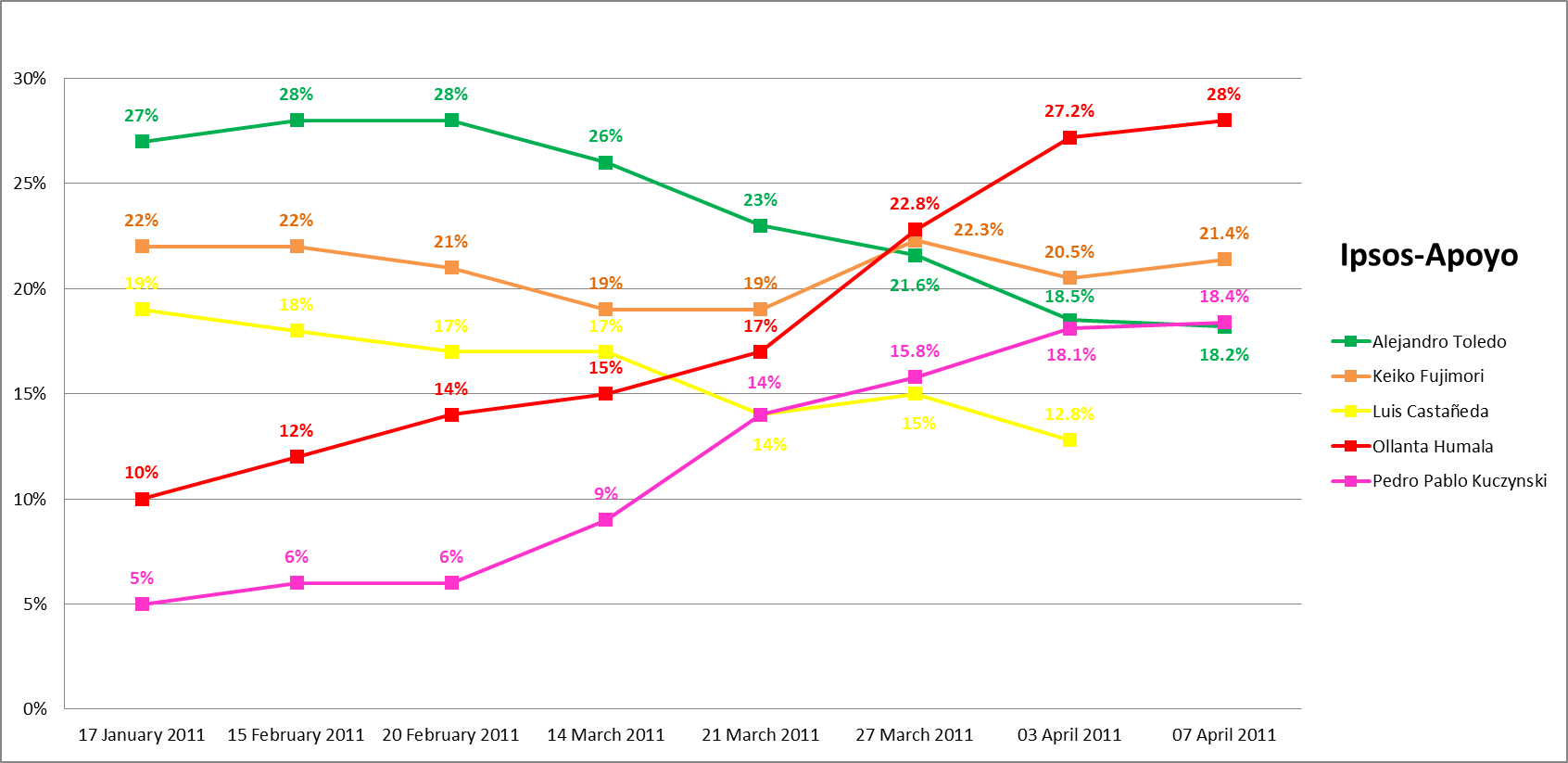
As in 2006, Ollanta Humala finished first in Sunday's presidential primary. He did so by improving his first round take by more than 500,000 votes over 2006 in a crowded field populated by former president Toldeo, former dictator's daughter Keiko Fujimori, former finance minister Pedro Pablo Kuczynski, and former Lima mayor Luis Castaneda. Some questions:

1. Will Humala be immune from the same fate he suffered in 2006 when he was overtaken by APRA's Alan Garcia in the second round? Even before his second term, Garcia was much more of an "establishment" candidate & Peruvians, mistrustful of Humala, flocked to him in the second round. In contrast, Peru has just selected two candidates with perhaps the highest negatives in the entire field. Will this fact, along with Humala's repolished, more moderate brand be enough for him to hold off Keiko?

2. Who will Keiko siphon off votes from? It's unclear what candidate's base will move to her in large numbers. Toledo led the fight against her father through much of the 90's, Kuczynski's voters, mostly found in Lima, were attracted to his technocratic skill, in contrast to Fujimori's authoritarian appeal. She never attracted more than 22% in the Ipsos-Apoyo poll and took 23% on Sunday. How much more of a share can she cut out for herself? It seems to me that there are the father and daughter die-hards, and there's the rest of Peru.

3. What narratives will Humala & Fujimori try to build for themselves and their opponent between now and June 5? Remember that in 2000, Humala led a failed coup against Fujimori in his final days in office, so there is some bad blood between the two. Also, Keiko would be well-advised to forgo mentioning el chino in public until after the election, the perception is already firmly rooted that she is seeking the presidency in order to pardon her father...a wish shared only by her father's diehards. Lastly, the Chavez factor; will Humala be able to shed the alliance with Chavez, which he worked hard to create during the 2006 election?

Tuesday, November 24, 2009

Chile and Peru

If Chile and Peru are not quarrelling about the origins of Pisco, it's maritime borders, or the intemperate remarks of Peruvian generals about sending their southerly neighbors home in plastic bags, or any other subject under the hot Atacama Desert sun. For well over a hundred years the two have engaged in cheap shots, snubs, the sheltering of would be coup plotters, and all out war with each other.

Of late, the belligerents are at odds over the alleged discovery of a
spying operation conducted by Chile which led to the arrest of a mid-ranking Peruvian Air Force officer. Peru's President, Alan Garcia, accused Chile of acting like a dictatorial pseudo-republic. Chile's outgoing President, Michelle Bachelet, has called the charges offensive and said that Chile is not in the business of spying.

South America's foreign affairs and defense ministers will
meet on Friday in Ecuador. We'll check in to see if a smack-down ensues.

Thursday, July 23, 2009

Bad Month for Peruvian Presidents

First, Alan Garcia turned his cabinet upside down, shaking out seven of his sixteen ministers. His prime minister, Yehude Simon, was clearly the biggest loss. A former and perhaps future (why not?) opponent, Simon lasted only nine months before resigning due to the tragically mishandled unrest in Bagua. He's replaced by another Lambayeque politician, APRA loyalist Javier Velasquez. So much for 'The Team of Rivals' approach.

Next, former president, Alberto Fujimori was sentenced this week to seven and a half years for paying off his shadow president, Vladimiro Montesinos, $15 million USD to skip town in 2000. Add that to the 31 years he has already been handed for the Barrio Altos and La Cantua massacres. For an excellent examination of the puzzling relationship between Fujimori and Montesinos read,
The Imperfect Spy by Sally Bowen and Jane Holligan.

Tuesday, June 23, 2009

Peruvian Legislature Revokes Decrees, Garcia Grovels


President Garcia admitted mistakes, copped to exaggeration, and essentially committed
political seppuku on national television last Wednesday. The following day, Peruvian lawmakers voted to repeal two presidential decrees that fomented armed conflict between security forces and indigenous communities in the Amazon.

Opposition leaders continued to hammer away, singling out seven more mandates for repeal that the president issued last year as he sought passage of a free trade agreement with the US. Yehude Simon, the Prime Minister, has tendered his resignation though it has been rejected by Garcia, he clearly recognizes that others will be needed in order to properly dilute culpability.

Tuesday, June 9, 2009

Alberto Pizango Granted Asylum


LivinginPeru.com reports that indigenous leader Alberto Pizango has been granted asylum by the Nicaraguan government. Pizango, the most prominent voice of AIDESEP, La Asociación Interétnica de Desarrollo para la Selva Peruana, first fled to the Nicaraguan embassy in Lima at some point after orders for his arrest came down from Garcia's government. It is unclear whether he has left Peru yet.

A couple of other points:
  1. There is disagreement over the death toll in Bagua. Peru's Ombudsman and the government maintain that 24 police officers were and 9 indigenous protesters were killed while members of AIDESEP say that over 30 protesters were killed and their bodies were burned and thrown in the river.
  2. Carmen Vildoso, Peru's Minister of Woman's Affairs and Social Development, has submitted her resignation following the violence in Bagua. She joined the government last fall alongside Yehude Simon, the Prime Minister.
  3. Keiko Fujimori, sensing a political opportunity I imagine, has called on the Prime Minister to resign and for the legislative decrees which paved the way for the resource extraction projects in las Amazonas to be temporarily suspended. Regarding the latter point, La Republica writes, "Sin duda, un extrano apoyo." 
Garcia's Aprista government has found itself in its most serious political crisis to date, and we're talking about some solid contenders here. Simon, the PM, seems to be the short-term target of the opposition. If they are able to force him out then Garcia will not have a single further success in office prior to the 2011 elections. He will be cooked, as Caretas put it so eloquently upon his election, en su salsa. 

Saturday, June 6, 2009

Peruvian Reaction

The following clips survey the reaction from yesterday's violence in Bagua, Peru
  1. Alberto Pizango, leader of AIDESEP (Interethnic Association for the Rainforest Development)
  2. Graciela Pirugia (?), family member of slain protesters
Interestingly, these individuals were speaking from La Victoria, a district in central Lima. From what they say,  it sounds like they were in Bagua during the morning of June 5. Members of Congress were present at this press conference as well. The Peruvian press is reporting that the government has ordered the arrest of Pizango.

Here is reaction from the President Alan Garcia.

Friday, June 5, 2009

Violence in Peru


The Utcubamba Valley

The AP is reporting that up to 36 people have been killed in violent clashes in the northern province of Utcubamba. Reports from the Lima based La Republica say that the government has confirmed the deaths of 11 police officers and 3 protesters. The AP also states that no independent reporters were present along the highway near the provincial capital, Bagua, when the violence broke out.

At the center of this civil strife is a strong disagreement between the federal government and local residents regarding natural resource extraction in the Peruvian Amazon. I think it can be clearly shown that President Garcia, who has become one of the most ardent supporters of the so-called Washington Consensus during his second round as president, has poorly managed the roll-out of these large oil, timber, and hydroelectric projects. The process of fostering stakeholders and mitigating negative attitudes towards such dubious projects has been disastrously executed. The vacuum that has been created by this strong mistrust between indigenous communities and the government has led to the resurgence of the Sendero Luminoso in several parts of Peru.

In return, his presidency which is full of many other dubious accomplishments, will always be remembered for the violence that occurred on June 5, 2009 in the Peruvian jungle.